

Choosing Ironmongery for Driveway Gates Well
Updated: Oct 6
A pair of well-made wooden driveway gates can last for many years, but only if the fittings supporting them are up to the job. Choosing ironmongery for driveway gates is not simply a matter of picking a black latch and hinges that look the part. The weight of the gates, the size of the posts, the opening arrangement and the exposure of the driveway all affect what will work safely and reliably.
Ironmongery should suit the gate first, then the appearance of the property. A decorative fitting that is too light for a large pair of timber gates will soon cause sagging, binding or loose fixings. Equally, oversized fittings can look clumsy on a modest entrance. Getting the balance right at the outset saves adjustment work and replacement costs later on.
Start with the gate weight, width and opening
The heavier and wider the gate leaf, the more demanding it is on its hinges and posts. This is particularly relevant for made-to-measure driveway gates, where a wider opening may call for substantial leaves rather than standard-sized gates. Engineered timber construction and sound mortice and tenon joinery provide a strong starting point, but the ironmongery must still carry the load correctly.
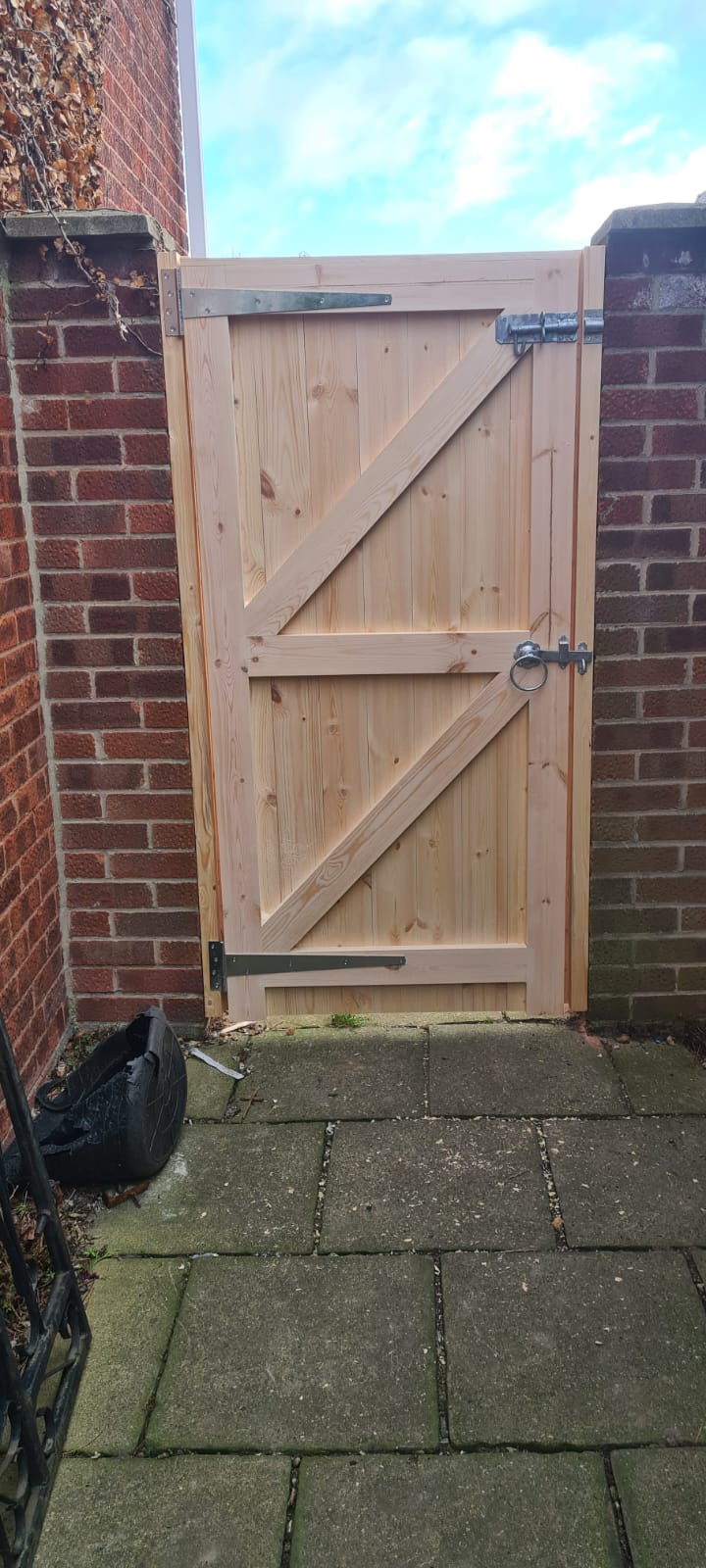
For most traditional timber driveway gates, hook and band hinges are the usual choice. The long hinge bands spread the load across the back of the gate rather than concentrating it around a small fixing point. This helps to reduce stress on the timber and keeps the gate better supported over time.
As a general rule, larger driveway gates need longer bands and heavier hooks. A short band fitted to a wide gate leaves too much unsupported timber beyond the end of the hinge. The result can be a gate that gradually drops at the closing edge. It is worth checking the hinge manufacturer's weight rating, but this should be treated as a guide rather than the only decision point. Wind exposure, frequent use and automated opening all add strain.
Adjustable hook and band hinges
Adjustable hinges are often a sensible investment for driveway gates. They allow the gate position to be fine-tuned after fitting, which is useful as new posts settle, ground levels vary or small adjustments are needed to maintain an even gap between the two leaves.
A fixed hinge can look neat and traditional, but it gives the installer less room to correct alignment. On a sheltered, level entrance with substantial posts, fixed fittings may be perfectly suitable. On a long or sloping driveway, or where gates are particularly wide, adjustable fittings offer welcome practical flexibility.
The hooks must be fitted to properly sized gate posts or masonry, not simply to a lightweight timber support. A gate is only as secure as the structure carrying it. If posts are being installed at the same time as the gates, allow for their section size, depth in the ground and the weight they will support before ordering any fittings.
Choosing ironmongery for driveway gates that stays secure
Hinges allow the gates to move, but the remaining ironmongery controls how they close, stay shut and hold in position. For a pair of manual driveway gates, this usually means a centre latch, a means of securing the gates, and drop bolts or a gate stop.
A centre latch holds the two leaves together when closed. A traditional Suffolk latch can suit a lighter pedestrian-style gate, but for driveway gates a heavier-duty latch or gate catch is generally more appropriate. The fitting needs to be easy to operate from the side where you approach the gates, while also being positioned so it does not interfere with any diagonal braces or framing.
Drop bolts are essential on many double gate arrangements. One gate leaf is normally held in place with a drop bolt that engages into a socket in the driveway surface. The second leaf then closes against it. This stops the pair from moving in the wind and takes pressure away from the latch.
Consider where the drop bolt will land before fitting. A socket in loose gravel can fill with stones and dirt, while one set into a poorly laid block paving joint may work loose. A proper receiver plate or socket set securely into a suitable hard surface is a better long-term arrangement. For gates opening inwards, an upper bolt can also secure one leaf to the post when the gates are closed.
Security requirements vary. A gate at the front of a busy property may need a lockable latch or a padlockable arrangement, while a rural entrance may benefit from a more substantial sliding bolt and a protected lock. The important point is that locking ironmongery should secure the gates without forcing the timber out of line. If the gates have to be lifted, pushed or pulled hard before the lock engages, the hinges or gate stop need adjustment.
Do not overlook gate stops and opening control
A gate stop is a small item with a large role. It provides a firm closing point, helping keep the gates aligned and preventing them from swinging past their intended position. For double driveway gates, a centre stop can create a clean meeting point and reduce movement when the wind catches the leaves.
Opening control matters just as much. A wide wooden gate can gather force quickly in a strong gust, especially at an exposed property. A cabin hook, holdback or purpose-made gate restraint can hold each leaf safely in the open position. This is useful when bringing cars in and out, and it prevents the gate from striking a wall, fence or vehicle.
Do not rely on a loose chain or improvised timber block. These may work temporarily, but they are inconvenient and can create a trip hazard. Ironmongery should make the gates easier to use every day, not introduce another awkward job each time you arrive home.
Match the finish to the setting and maintenance plan
Black ironmongery remains a popular choice for timber driveway gates because it gives a traditional, purposeful finish. It works particularly well with natural timber tones, painted gates and country-style properties. However, not all black fittings are finished in the same way.
Powder-coated steel gives an even appearance and can provide good protection when the coating remains intact. Galvanised fittings have a more utilitarian silver-grey appearance but offer excellent corrosion resistance, making them a practical choice for coastal locations, exposed driveways or areas that stay damp. Some galvanised products are also supplied with a black coating, combining the familiar look with added protection.
The best choice depends on where the gates are fitted. A sheltered driveway in a town may be well served by quality black-coated fittings, checked and maintained regularly. A property near the coast, on high ground or exposed to road salt needs greater attention to corrosion resistance. In these conditions, galvanised components and stainless steel fixings are worth considering.
Even good ironmongery benefits from inspection. Check moving parts for wear, keep hinge pivots free of packed dirt and apply a suitable lubricant where required. If a coated finish is chipped during installation or use, touch it up promptly before rust takes hold. This simple maintenance is especially worthwhile on handmade gates that have been built to give many years of service.
Use the right fixings for timber gates
A strong hinge is of little use if its screws or coach bolts are undersized. Driveway gate ironmongery should be fixed with hardware suitable for exterior timber and the loads involved. Through-bolting is often preferable for substantial hinge bands, as it provides a secure mechanical fixing through the gate frame.
Avoid placing fixings too close to the edge of a timber rail, where they may encourage splitting. Pre-drilling can help, particularly near the ends of rails or when using large coach screws. Washers should be used where appropriate to spread the load, and all fixings should be checked after the gates have been in use for a short period.
There is also a visual consideration. Bolts, nuts and washers will be visible on the gate face with many traditional hinge arrangements. Choosing fittings that complement one another gives a much tidier result than mixing different finishes and styles.
Plan ahead if the gates may be automated
If you intend to automate your driveway gates now or in the future, say so before ordering. Automation changes the demands placed on hinges, posts, closing hardware and the gate design itself. The gates must be correctly hung, evenly balanced and able to move freely before an operator is fitted.
Automated gates generally need purpose-designed safety equipment, including controls that stop or reverse movement if an obstruction is detected. Manual latches and drop bolts can also become unsuitable if they must be released by hand every time the gates are used. An installer can advise on the correct arrangement, but early planning avoids buying fittings that later need to be removed.
A well-built gate deserves ironmongery chosen with the same care as the timber itself. Measure the opening accurately, consider how the gates will be used in all seasons, and select fittings that support the weight rather than merely decorate it. If you are unsure, sharing your gate size, post details and a photograph of the entrance with a specialist before ordering can prevent a costly mismatch and help your new driveway gates feel right from the first swing.


Great insights on choosing the right ironmongery for driveway gates. Quality hinges, latches, and fittings play an important role in ensuring smooth operation, durability, and long-term performance. Proper hardware selection can also enhance security and appearance. For modern gate solutions, explore Driveway Gates Melbourne for reliable options.